
EAM Jaishankar's mission is aimed at strengthening India's strategic autonomy in a complex international environment, observes Ambassador M K Bhadrakumar.

Prime Minister Narendra Modi was on Tuesday officially conferred the 'Order of St Andrew the Apostle' award by Russian President Vladimir Putin for his contribution to fostering bilateral ties between the two countries.
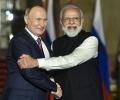
Prime Minister Narendra Modi and President Vladimir Putin held the 21st India-Russia summit, covering an array of areas with an aim to further enhance the special and privileged strategic partnership between the two countries.

The statement hinted at China's eagerness not to upset the United States, with which it want to maintain good relations.
Boosting their military ties, India on Monday inked deals worth around $3 billion with Russia to procure 42 new Su-30 MKI combat aircraft and 71 Mi-17V5 medium-lift helicopters.

Prime Minister Manmohan Singh fted Russian President Dmitry Medvedev over lunch at home on Tuesday, but before that a bagful of agreements were signed at Hyderabad House in the capital, as well as on the margins of the summit, signalling that the suspicion and mutual agreement, which has been a key feature of the recent past, now truly belonged there.

India seeks to play a supportive role for a peaceful and stable region, Prime Minister Narendra Modi said on Monday as he embarked on a high-profile visit to Russia to hold summit talks with President Vladimir Putin amid the conflict in Ukraine.
The Russian foreign minister said the three countries only enjoy "prominence" in Moscow's foreign policy.

In a move aimed at boosting India's defence sector, 200 helicopters will be manufactured in the country with Russian collaboration as part of intensification and diversification of their strategic ties.

India on Tuesday said cooperation in peaceful uses of nuclear technology is an important pillar of the multifaceted cooperation with Russia, which offered help in building small tropical nuclear power stations.
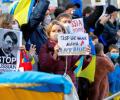
'The Indian activities at the UN are fully reflecting the merit of our special and privileged strategic partnership'

Russia President Vladimir Putin on Monday described India as a great power, a friendly nation and a time-tested friend and echoed common concerns over terrorism, drug trafficking and organised crime as he held wide-ranging talks with Prime Minister Narendra Modi.
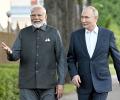
Ahead of Modi-Putin talks, the US called upon India to make it clear to Russia that any resolution of the Ukraine conflict must respect the United Nations charter and Ukraine's territorial integrity and sovereignty.

He said both countries are opening new areas of cooperation in the energy sector, telecommunications and science and technology and they have set up funds to facilitate investment in high technologies.
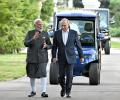
The two leaders will hold wide-ranging talks at the 22nd India-Russia annual summit on Tuesday that is largely being seen in the context of wider geopolitical turmoil arising out of the Russian invasion of Ukraine.
India and Russia on Monday decided to extend the tenure of an inter-governmental commission for military cooperation by another 10 years to 2020. The two sides inched closer to resolving the Gorshkov aircraft carrier price and T-90 tanks technology transfer issues. New Delhi and Moscow also decided to form an apex body headed by the defence secretaries of the two countries to coordinate the operation of several working groups for military cooperation.

Both Putin and Zelenskyy have invited the prime minister to visit Russia and Ukraine respectively after the Lok Sabha elections, sources said, adding they see Modi as a "peacemaker".

"We have decided to send officials from both sides to sit on table either in New Delhi or Moscow to remove the bottlenecks, including clinical trials of new drugs," Azad told the Indian media after meeting his Russian counterpart Tatiana Golikova.

The scaling up of the India-US strategic partnership to the level of non-NATO ally with defence deals, sharing and transfer of defence technology, interoperability, joint collaboration and joint production of defence equipment has exacerbated Moscow's anxiety, notes Rup Narayan Das.

Prime Minister Narendra Modi on Friday pushed Russian President Vladimir Putin to end the conflict in Ukraine, saying 'today's era is not of war' even as he called for finding ways to address the global food and energy security crisis.
In a boost to the sagging defence relationship between India and Russia, the two nations on Friday signed a contract for supply of 80 MI-17V-5 medium lift helicopters for the Indian Air Force. Valued at $1 billion, the agreement between the two sides comes at a time when New Delhi and Moscow are squabbling over several defence related deals signed earlier.
Foreign Secretary Shiv Shankar Menon said in New Delhi that, "Both India and Russia are keen to expand nuclear cooperation. All the preparatory work has been done." He was inaugurating an international conference on "Changing Patterns of Indo-Russian Cooperation" organised by the Observer Research Foundation. He said that India and Russia already have an "excellent relationship" and India considers relations with Russia very important.
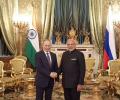
Modi, who arrived in Moscow on Wednesday on a two-day visit, held talks with Putin during a restricted meeting in Kremlin to begin the 16th India-Russia Summit.
Defence Minister A K Antony will co-chair the commission meeting with Russian Defence Minister Anatoly Serdyukov to hold talks on a wide-ranging agenda of military technical cooperation, covering key spheres, including timely delivery of contracted military systems, in the light of the reported settlement of the cost-escalation issue and supply of defence systems.

India has strongly rejected as "baseless" allegations of its interference in Canadian elections and asserted that the core issue has been Ottawa's meddling in New Delhi's internal affairs.

Earlier, Modi met Jinping seperately and the two leaders concurred there had been a perceptible improvement in bilateral relations.

Johnson said Modi has been 'very strong' in his reaction to what happened in Bucha in Ukraine and that everyone understands and respects New Delhi's decades-old historic relationship with Moscow.
After protracted re-negotiations, India and Russia have ended the stalemate over contentious price and technical issues for the Admiral Gorshkov aircraft carrier which had become an irritant in bilateral ties.

The two countries also asked all nations to stop cross-border movement of terrorists and asserted that a decisive collective response from the international community without 'double standards and selectivity' was required to combat the threat of terrorism.
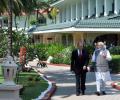
Big ticket defence deals including purchase of missile systems, frigates and joint production of helicopters were sealed on Saturday.
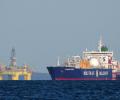
Russian oil supplies to India will continue to flow unhindered and suppliers will come up with ways to sidestep secondary sanctions, a Russian official told Business Standard.
Dr Singh reminded that today, most of the equipment used by the three wings of the Indian armed forces is of Russian origin.

He may have spent his entire adult life in diplomacy, but doctorate in nuclear physics Subrahmanyam Jaishankar's face betrays both fusion and fission of his moods.
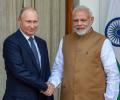
"We foresee a very intensive engagement during the day that will culminate in the summit," the MEA spokesperson said.
'Russia is not out to violate what they see as their international obligations.' India's Ambassador to Russia Kanwar Sibal in an exclusive interview.
Foreign policy is always a work in progress and ups and downs are built into foreign policy process. What is permanent is national interest. Hopefully, this year, which will also witness general elections in the country, will also clear clouds in the foreign policy horizon, observes Rup Narayan Das.
India will be identifying and separating its civilian and military nuclear facilities and programmes in a phased manner.
